Automated Bar Systems: How They Work and How to Choose One
Automated bar systems — also called automatic bar machines, robotic bars or cocktail robots — cover a range of technologies that prepare drinks with reduced manual work. This guide explains the categories, the engineering behind liquid dispensing, and the evaluation criteria that matter for bars, hotels, restaurants and beverage equipment distributors.
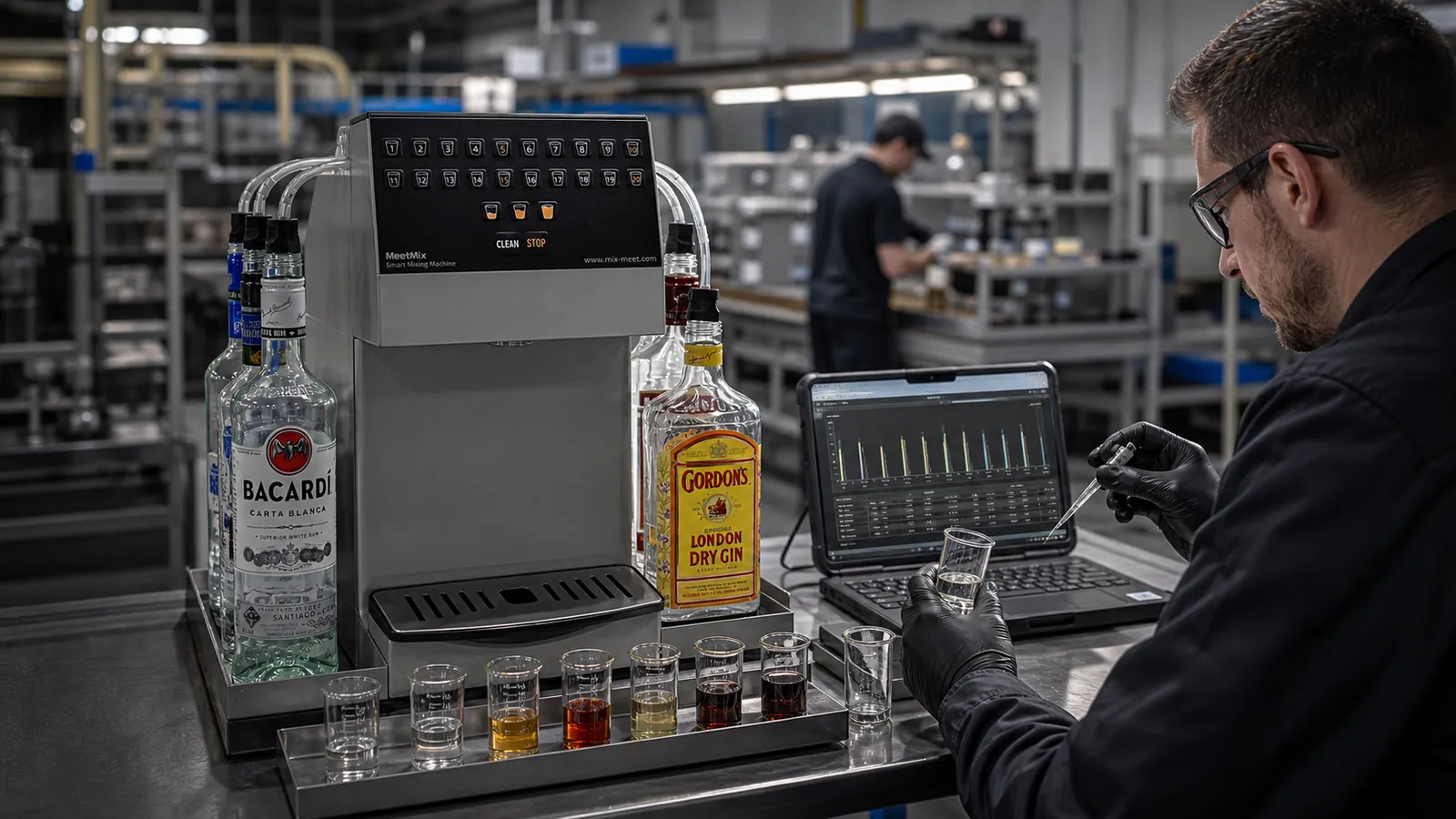
What counts as an automated bar system
The term is used broadly. In practice, four categories appear in commercial venues:
- Automatic cocktail dispensing machines — countertop or freestanding units that hold liquid ingredients in dedicated channels and dispense stored recipes. This is the most common and most serviceable category, and the focus of this guide.
- Self-service cocktail kiosks — dispensing systems with payment integration, designed for unattended operation in hotels, event spaces or entertainment venues.
- Robotic arm bars — articulated robots that mix, shake and garnish drinks in view of guests. High visual impact, but mechanically complex and slow per drink.
- Back-of-house drink production systems — machines integrated into service workflows to produce consistent output for restaurant and banquet service, without guest visibility.
The categories answer different problems. The first two solve consistency and staffing; the third sells an experience; the fourth solves volume and speed in structured service. Buyers should know which problem they are solving before comparing specifications.
How a dispensing-based automatic bar machine works
Most practical automated bar systems — including the MEETMIX S12plus and S6plus platforms — are built around controlled liquid dispensing:
- Ingredient channels. Each channel connects one liquid ingredient — a spirit, liqueur, syrup or mixer — to a dosing path. Food-grade tubing carries product from container to pouring point.
- Recipe storage. A recipe defines the exact volume of each ingredient. The machine stores the menu and reproduces the recipe on selection.
- Portion control. Defined cup sizes keep presentation and alcohol content consistent, which matters both for guest experience and for responsible service.
- Control electronics. The controller sequences channels, manages recipes and exposes a management interface for menu changes and settings.
The result is a drink that does not depend on the operator’s skill, the hour of the night or the pressure of service. For venues, that repeatability is the commercial core of the technology: a cocktail program that survives staff turnover.
Automated bar vs. trained bartender
An automated bar system does not replicate a bartender’s full range. It wins on three specific axes:
- Consistency — the same recipe produces the same drink, every time, across locations.
- Speed of onboarding — service staff can operate the cocktail menu after a short introduction.
- Throughput at peak — repeatable dosing without queues when demand spikes.
Bartenders remain better at improvisation, guest interaction, presentation and unusual requests. Many venues combine both: the machine covers the repeatable core of the menu, bartenders handle premium and signature service. Others place the machine where no bartender is economically viable — a hotel lounge in off-hours, a banquet floor, a self-service point.
Evaluation criteria for buyers and distributors
Channel count against the planned menu
Every recipe consumes channels for each distinct liquid it needs. Six channels support a focused menu; twelve channels support broader programs with multiple signatures. Count the ingredients in your target menu — including mixers — before looking at any model. This is the single most common purchasing mistake in the category.
Dispensing precision and ingredient compatibility
Not every liquid behaves the same. Viscosity, pulp content, carbonation and temperature all affect dosing behavior. Ask the supplier which ingredient types are validated, what the limits are for thick syrups or particulate mixers, and how the system behaves when an ingredient runs low. A responsible manufacturer will describe limits rather than claim universal compatibility.
Cleaning architecture
Any system that dispenses sugar-bearing liquids needs a daily cleaning routine. Compare: how product-contact parts are cleaned, whether parts are removable, the duration of the cleaning cycle, and which cleaning agents are required. Systems with a documented cleaning regime fit commercial hygiene standards; systems without one create audit risk in hotels and restaurants.
Durability and service path
A commercial automatic bar machine runs daily for years. Evaluate the housing material, the reputation of the mechanism, the availability of spare parts and the local service path. For distributors, the service question decides whether a product can be sold at all: field-replaceable parts and clear documentation are what make after-sales support scalable.
Management and menu control
Check how recipes are edited, portion sizes defined and menus locked. Multi-site operators need the same recipe set on every machine; management-level control keeps the program stable even as staff change.
Installation footprint
Compare width, depth, weight and power specification against the actual bar counter. Compact six-channel units fit standard counters; twelve-channel units need more width; self-service kiosks need floor space, power and possibly network access for payment terminals.
Where automated bar systems pay off fastest
| Venue | Typical value |
|---|---|
| Hotel lobby bar | Cocktail service in off-hours without dedicated staff |
| Restaurant | Beverage revenue without hiring a bartender |
| Nightclub / venue | Peak-hour throughput and portion control |
| Banquet / catering | Uniform output for large groups in short windows |
| Event / self-service point | Unattended or semi-attended drink production |
Working with a manufacturer
Distributors and venue groups that expect volume, customization or market-specific configurations benefit from buying at the manufacturing level. A manufacturer can validate ingredients, confirm specifications in writing, and discuss OEM/ODM adaptations — refrigeration, carbonation, interfaces, housing and control electronics — as a project rather than a wishlist. See how MEETMIX works as a cocktail machine manufacturer and the OEM/ODM project overview.
Frequently asked questions
What is the difference between an automated bar system and a cocktail machine? In practice the terms overlap. “Automated bar system” often describes larger or self-service installations, while “cocktail machine” describes countertop dispensing units. Technologically, most practical systems in both groups are channel-based liquid dispensers with stored recipes.
How many cocktails can an automated bar system make? Machine-dependent. The limiting factors are the number of stored recipes, the number of connected ingredients and the practical menu design — not a universal count.
Can the machines serve carbonated cocktails? Standard dispensing platforms handle still liquids; carbonation is a project-level option. Confirm feasibility with the manufacturer before planning a sparkling menu around a standard model.
What maintenance does an automatic bar machine need? Daily cleaning of product-contact parts, scheduled inspection of tubing and seals, and ingredient replenishment. A written cleaning routine is part of the commercial specification — see our maintenance guide.
Next steps
Write down the target menu, count its liquid ingredients, and match that number against the channel count of candidate machines. Then request written specifications, the cleaning routine and the service path before committing. For a structured procurement process, the B2B buying guide and automatic cocktail machine introduction cover the remaining selection criteria. Distributors and venue groups can request specifications and cooperation terms via the MEETMIX contact page.