Cocktail Machine for HoReCa Venues: The Complete B2B Buyer Guide
HoReCa operators — hotels, restaurants and catering businesses — evaluate beverage equipment differently from home users. This guide explains how a commercial cocktail machine fits into hotel, restaurant and event operations, which selection criteria matter for HoReCa procurement, and how distributors can position automated dispensing equipment in this segment.
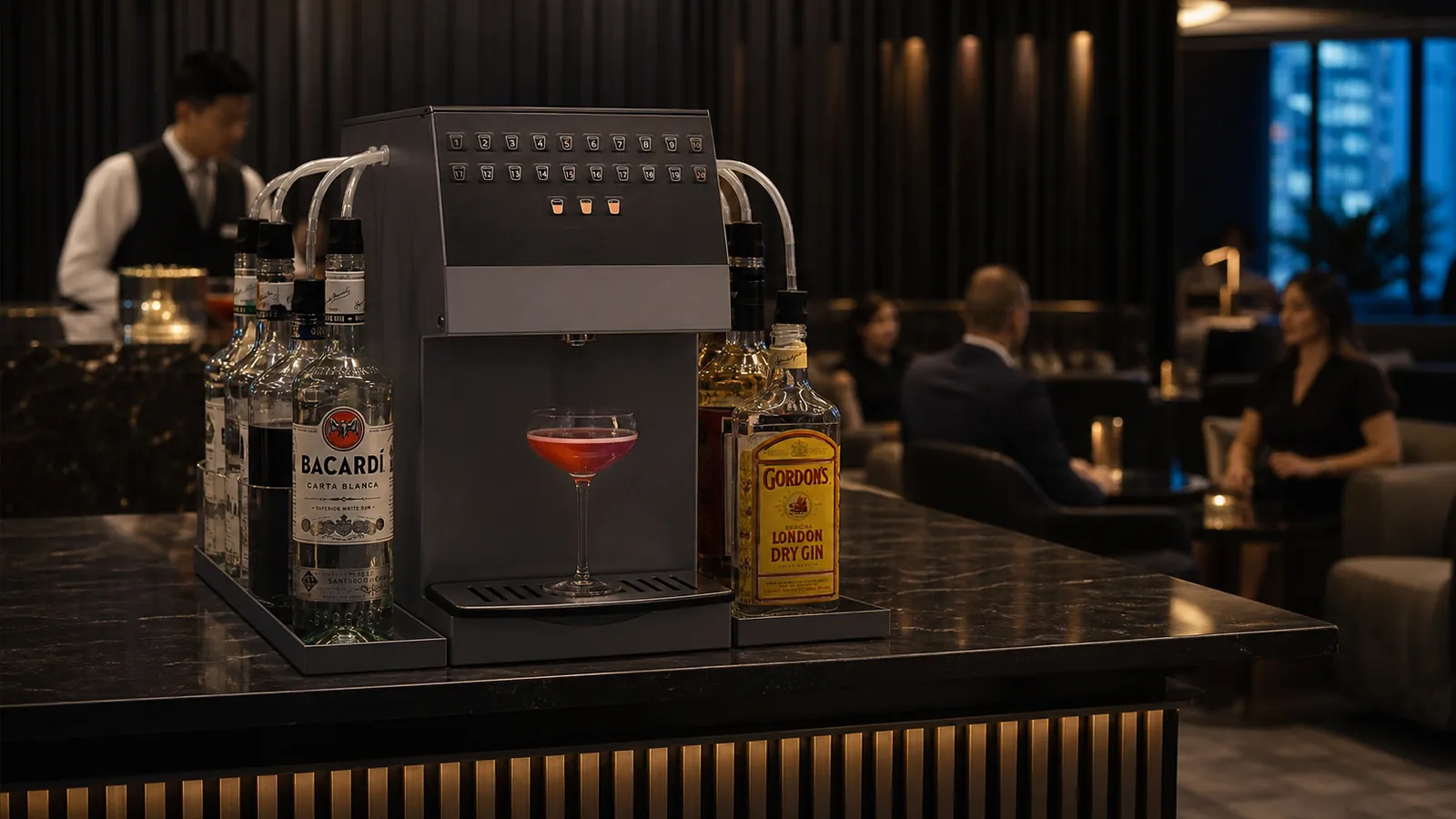
What “HoReCa” means for beverage equipment decisions
HoReCa — hotels, restaurants and catering — describes businesses where beverages are produced in commercial volume, across multiple shifts, by staff with different skill levels. Unlike a home enthusiast buying a cocktail machine for weekend use, a HoReCa buyer evaluates the machine as part of an operating system: the menu, the workflow, the cleaning routine and the service promise to guests.
This distinction drives every recommendation in this guide. A machine that performs well in a demonstration may still fail in a hotel if it cannot survive shift changes, peak-hour repetition or the venue’s hygiene regime. Procurement teams therefore look past the drink itself and assess the machine as a commercial appliance.
1. Match the machine to the venue type
Different HoReCa venues put different pressures on an automatic cocktail machine:
- Hotel lobby bars and lounges value consistency across shifts. A guest ordering the same signature cocktail at 6 p.m. and midnight should receive the same drink. Stored recipes and defined portion sizes support this.
- Restaurants often add cocktails to expand beverage revenue without hiring a dedicated bartender. A dispensing machine lets existing service staff prepare a controlled cocktail menu.
- Event and catering operations need fast, repeatable output during short service windows. Recipe selection speed and simple operation matter more than menu breadth.
- Club and entertainment venues prioritize throughput during peak hours, where manual preparation creates queues and inconsistent drinks.
Before comparing models, write down where the machine will be installed, who will operate it and how many covers or guests the venue serves per service. This single page of context prevents most selection mistakes.
2. Ingredient channels: the first hard limit
The number of liquid ingredient channels determines the maximum complexity of the cocktail menu. Each recipe draws from the connected spirits, liqueurs, syrups and juices. A compact machine with six channels covers a focused menu of popular highballs and simple cocktails. A twelve-channel machine supports a broader menu with layered recipes and multiple signature drinks.
HoReCa venues should plan the menu first, then count the distinct liquid ingredients it requires — including garnish-compatible syrups and mixers — before choosing the channel count. Distributors should run the same exercise with each customer, because the channel count is also the clearest up-sell lever between models.
The MEETMIX S6plus (six channels, 39 cm wide) and the MEETMIX S12plus (twelve channels, 68 cm wide) illustrate the trade-off: footprint versus menu depth. Venues with limited bar counter space often accept a narrower menu; venues building a cocktail program around signature drinks choose more channels.
3. Recipe management and consistency
The commercial value of an automatic cocktail machine in HoReCa comes from repeatability, not novelty. Evaluate how the machine stores recipes, how portion sizes are defined and how management locks or edits the menu:
- How many beverage recipes can be stored, and how easily can recipes be duplicated across multiple machines in one property?
- Can cup sizes be standardized so visual presentation stays consistent at the bar, in the restaurant and at events?
- Can the management layer restrict staff changes, so the menu survives staff turnover?
These questions matter more in multi-site hotel groups than in single bars, but they define how far the machine scales with the business.
4. Throughput and service workflow
An automatic bar machine changes the workflow at the point of service. In a restaurant, the machine may sit at the service station, producing drinks to order alongside the POS workflow. In a lobby bar, it may operate in view of guests, making quiet operation and presentation relevant. At events, it may run unattended in self-service mode with pre-portioned output.
Ask the supplier how the machine behaves in sustained service: recovery time between drinks, behavior when an ingredient runs out, and what the operator must do at the moment of service. A machine that requires multi-step intervention between drinks erodes the speed advantage that justified the purchase.
5. Cleaning and hygiene: the hidden daily cost
In HoReCa, cleaning is a daily, scheduled operation governed by hygiene standards and audit routines. The cocktail machine joins a cleaning plan that already covers coffee machines, draft systems and ice machines. Evaluate:
- Which parts contact product, and how are they cleaned — flushing, removable parts, or chemical circulation?
- How long does the daily cleaning cycle take, and does it fit before opening or after closing routines?
- What consumables or cleaning agents does the routine require, and are they available locally?
Food-contact materials matter here: food-grade silicone tubing and metal housing are baseline expectations for commercial machines. A detailed cleaning routine also protects drink quality, because residue in dispensing lines is the most common cause of off-flavor complaints in unmanaged systems. Our cleaning and maintenance guide covers the full routine.
6. Installation requirements: power, counter and water
Most countertop cocktail machines need a standard outlet and a level, stable counter with enough depth for the unit and its ingredient containers. Verify the electrical specification against the venue’s supply, the machine’s width against the bar counter, and the ventilation around the unit. Machines with refrigeration or carbonation options add installation constraints — compressor heat, clearance and possibly a water connection.
For hotels and restaurants, also plan the ingredient logistics: where the spirit bottles and mixers are stored, how they are refilled, and who is responsible for the daily restock. The machine is only as reliable as the ingredient supply chain behind it.
7. Staff training and turnover
HoReCa staffing rotates. The strongest argument for an automatic cocktail machine in this segment is that a new employee can serve the full cocktail menu after a short introduction, instead of weeks of bar training. When evaluating a machine, simulate the worst case: a temporary staff member, alone, during a busy service. If selecting a recipe, placing a cup and pressing one button completes the drink, the machine fits HoReCa reality.
8. Customization: refrigeration, carbonation and OEM projects
Standard models cover the core dispensing function. Venues and distributors with specific concepts — chilled ingredients, sparkling cocktails, branded interfaces or a fully custom product — should discuss customization early with the manufacturer. Cooling, carbonation, display, control electronics and housing can often be adapted in OEM/ODM projects, but feasibility, specifications and lead times must be confirmed before a market launch is planned around them.
This is where working with a manufacturer rather than a pure reseller pays off: the same engineering team that builds the standard machine can evaluate the custom variant. See our OEM/ODM overview for project categories.
9. What distributors should verify before listing a HoReCa cocktail machine
Equipment distributors serve venues they may never visit. Before adding an automatic cocktail machine to the portfolio, verify:
- Specification stability — are the published specifications (channel count, recipe capacity, power, dimensions, weight) confirmed in writing by the manufacturer?
- Spare parts and service path — which parts are replaceable in the field, and what does the repair path look like for a hotel customer?
- Cleaning requirements — can local service partners support the hygiene routine, or does it require trained technicians?
- Ingredient compatibility — which local spirits and mixers have been tested, and what guidance exists for viscosity or pulp content limits?
- Reference use — which hotel, restaurant or catering installations already run the machine in daily service?
Selection checklist
| Criterion | Question to answer |
|---|---|
| Venue fit | Where is it installed and who operates it? |
| Menu depth | How many distinct liquid ingredients does the planned menu need? |
| Consistency | Can recipes and cup sizes be locked across shifts and sites? |
| Hygiene | Does the cleaning routine fit daily venue operations? |
| Installation | Power, counter space, clearance and ingredient storage? |
| Training | Can temporary staff operate it after a short introduction? |
| Service path | Who repairs it, with which parts, in which market? |
Frequently asked questions
Is a cocktail machine suitable for small restaurants? Yes, when the goal is a controlled cocktail menu without dedicated bar staff. Compact six-channel models fit limited counter space and still cover a focused menu.
Can one machine serve a whole hotel property? Usually not a single unit. Hotels typically combine one machine per service point — lobby bar, restaurant, event floor — with the same stored recipes to keep the guest experience uniform.
Do these machines replace bartenders? They replace the repetitive dosing work, not the guest experience of a bar. Many venues position the machine in back-of-house service or as a supporting station, while keeping bartenders for premium interaction.
How do cocktails stay consistent without a bartender? Recipes are stored in the machine with defined liquid quantities per drink and standardized cup sizes, so the output does not depend on operator skill.
Next steps
Define your venue’s menu, installation space and service model, then compare models against that written requirement. For a broader comparison of channel counts and specifications, read the commercial cocktail machine buying guide and the introduction to automatic cocktail machines. Distributors and venue operators can request model specifications, customization options and cooperation terms through the MEETMIX inquiry page.